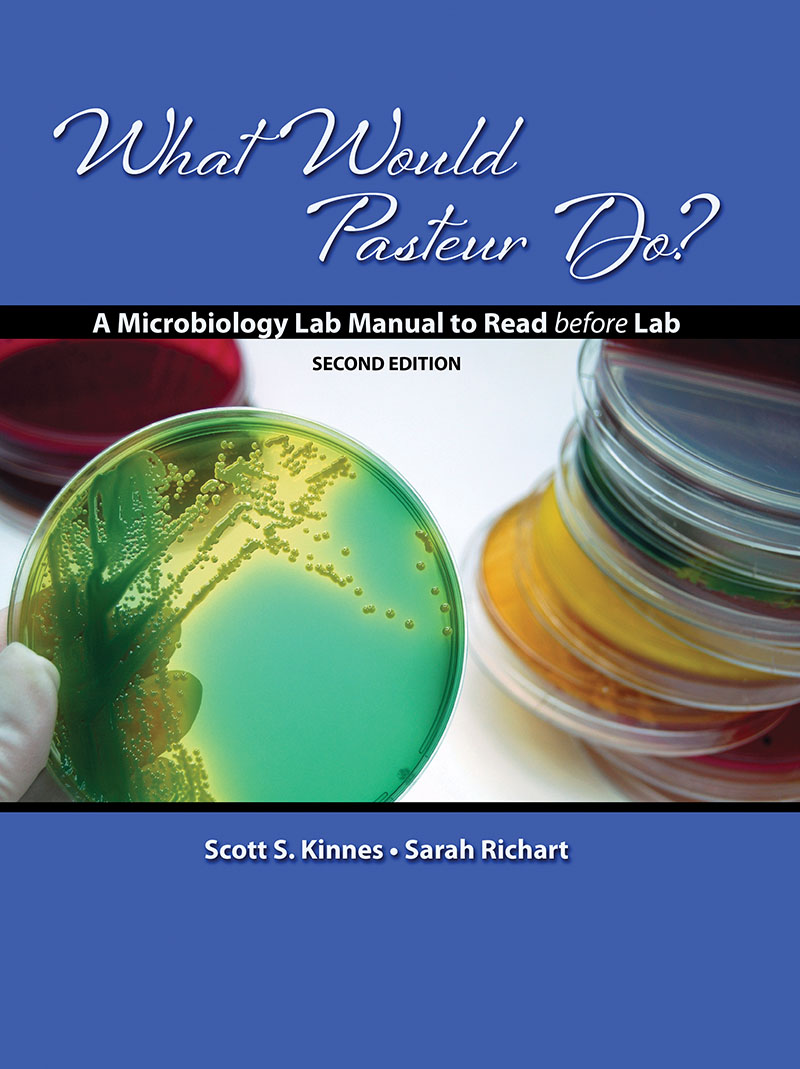
What Would Pasteur Do? A Microbiology Lab Manual to Read before Lab
Edition: 2
Copyright: 2012
Pages: 370
Edition: 2
Copyright: 2012
Pages: 370
Choose Your Format
Ebook
$60.78 USD
$109.40 USD
This laboratory course develops practical microbiology skills through training in laboratory safety, microscopy, aseptic technique, microbial culturing, staining methods, sterilization, microbial growth, and biochemical identification of microorganisms. It also covers molecular techniques, immunological assays, microbial metabolism, antibiotic susceptibility, and the identification of bacteria using biochemical tests and 16S rRNA gene sequencing, providing hands-on experience in microbial isolation, characterization, and diagnosis. The course further examines the microbiology of human body systems, food, water, soil, and fermented products, as well as epidemiology, disease transmission, microbial ecology, bacteriophages, and the biology of fungi, protozoa, and parasitic helminths.
1 Laboratory Safety
2 Basic Microscopy
3 The Necessity of Aseptic Techniques
4 Sterilization and Media Preparation
5 Aseptic Culturing Techniques
6 Isolation Techniques
7 Cultural Characteristics
8 Preparing a Smear for Staining
9 Simple Staining of Bacteria
10 Gram Staining Technique
11 Acid-Fast Staining
12 Endospore Staining
13 Effects of Oxygen on Microbial Growth
14 Effects of Temperature on Microbial Growth
15 Effects of Ultraviolet Radiation on Microbial Growth
16 Effects of Osmolarity on Microbial Growth
17 Effects of Antiseptics and Disinfectants on Microbial Growth
18 Effects of Antibiotics on Microbial Growth
19 Effects of Heavy Metals on Microbial Growth
20 Identification of an Unknown Bacterium Using Gram Staining and Biochemical Tests
21 Identification of an Unknown Bacterium Using 16S Ribosomal RNA Gene Sequencing
22 Carbohydrate Fermentation
23 Starch Hydrolysis
24 Methyl Red and Voges-Proskauer Test
25 Citrate Utilization Test
26 Decarboxylation
27 Deamination
28 H2S Production
29 Casein Hydrolysis
30 Gelatin Hydrolysis
31 Urease Production
32 Lipid Hydrolysis
33 DNase Production
34 Litmus Milk Reactions
35 SIM Medium
36 Triple Sugar Iron Agar
37 Catalase Test
38 Oxidase Test
39 Nitrate Reduction Test
40 Agglutination Reactions
41 Precipitation Reactions
42 ELISA Test for HIV-1 Diagnosis
43 Isolation of Plasmid DNA from Bacteria
44 Microbiology of the Oral Cavity
45 Microbiology of the Throat
46 Microbiology of the Digestive System
47 Microbiology of the Urinary Tract
48 Enterotube IITM Rapid Identification Kits
49 Staphylococcus Genus
50 Streptococcus Genus
51 The Ames Test
52 Epidemiology
53 Disease Transmission
54 Microbiology of Food
55 Microbiology of Fermented Beverages
56 Microbiology of Dairy Products
57 Microbiology of Water
58 Microbiology of Soil
59 Microbial Symbiotic Relations
60 Bacteriophage Growth in the Lab
61 Biology of the Fungi
62 Biology of the Protozoa
63 Biology of the Platyhelminthes
64 Biology of the Nematoda
Appendix: Microorganism Photographs
Scott Kinnes, PhD is a retired professor of biology at Azusa Pacific University (APU), where he served in the Department of Biology and Chemistry. His academic interests included ecology, evolution, general biology, and environmental science. Dr. Kinnes incorporated discussions of conservation and environmental responsibility into his teaching, helping students explore biological principles within broader scientific and ethical contexts.
Sarah Richart, PhD is a professor of biology and microbiologist whose expertise includes microbiology, virology, immunology, and environmental ethics. She earned a BS from the University of Illinois and a PhD from Colorado State University, followed by postdoctoral research in virology at the University of Alberta. Her research focuses on host–pathogen interactions between fungi and insects, vaccine history, microorganisms and global environmental change, and the relationship between humans and the natural world.
In addition to teaching, Dr. Richart serves as the program director for the Environmental Studies Minor and advises the Pre-Veterinary and Pre-Dental clubs. She is an American Scientific Affiliation Fellow, an APU Diversity Ambassador, and a Reader at the Huntington Library, contributing to education and research in microbiology, environmental science, and public health.