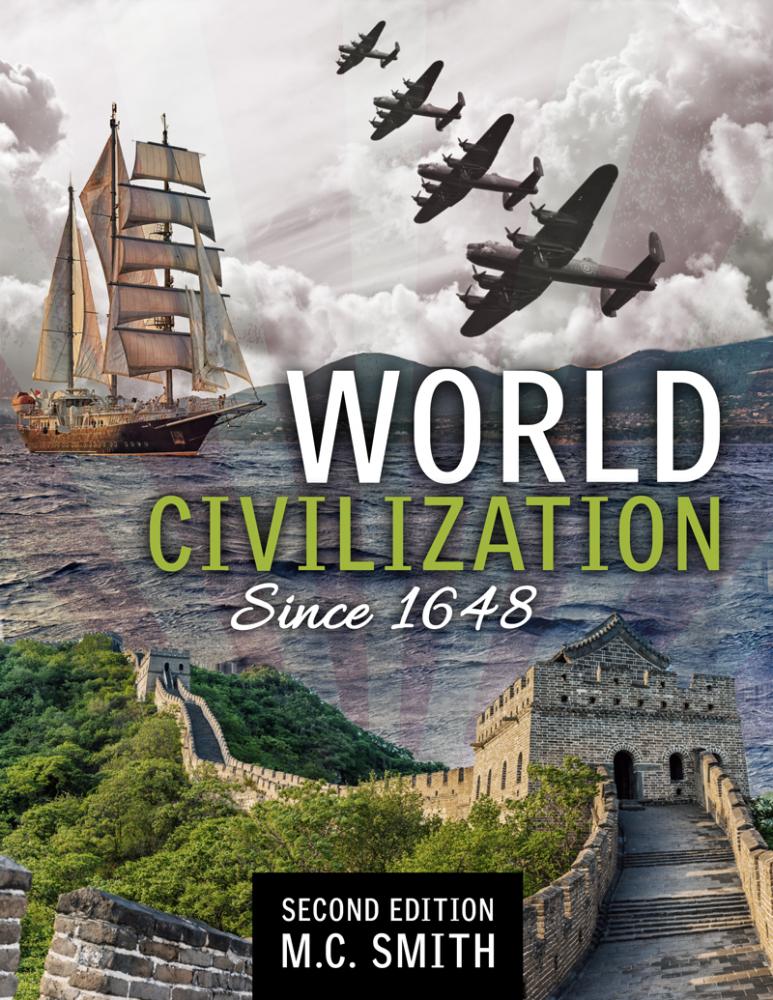
World Civilization Since 1648
Edition: 2
Copyright: 2021
Pages: 396
Choose Your Format
Ebook
$61.74 USD
This book offers a sweeping survey of world history from the mid-seventeenth century to the end of the Second World War, emphasizing how political power, economic systems, and ideas evolved in response to global change. It opens with a snapshot of the world in 1650, setting the geographical, economic, and political foundations that shaped early modern history.
The narrative then explores the rise and decline of major empires, particularly the Ottoman, Safavid, and Mughal states, before turning to Europe’s experience with absolutism, the Enlightenment, and imperial rivalry. Revolutionary upheavals in North America and France mark a decisive break with the old order, while the Napoleonic era and the Congress of Vienna attempt—ultimately imperfectly—to restore stability through balance-of-power politics.
The book then shifts to the profound transformations of the nineteenth century. Industrialization reshapes economies and societies, giving rise to new ideologies such as liberalism, nationalism, socialism, and imperialism. Europe’s political evolution is traced through reform, revolution, and realpolitik, while developments in the Americas highlight nation-building, civil conflict, and uneven liberation. These internal changes are set against a backdrop of aggressive global expansion, as European powers scramble for Africa, force concessions in China, and encounter a rapidly modernizing Japan that turns Western methods to its own advantage.
The final chapters examine the catastrophic consequences of these long-term processes in the twentieth century. Imperial competition, nationalism, and alliance systems culminate in the First World War, whose unresolved aftermath fosters economic instability and the rise of totalitarian regimes.
The book concludes with a detailed account of the Second World War, from its origins and early Axis victories to the decisive turning points and final defeat of the Axis powers.
Overall, the work presents history as a series of interconnected global processes, highlighting cause and effect across centuries and continents.
CHAPTER 1 World Tour, 1650
A snapshot of the globe in 1650, looking at political organization and economic relationships in broad strokes. Background information in terms of geography, trade, and past historical events to arrive at 1650. Cause and effect of processes in motion in 1650.
CHAPTER 2 God and Gunpowder: Three Muslim Empires
The rise of the Ottoman, Safavid, and Mughal Empires. A comparison of their governments and policies. An examination of their economics. An exploration of the causes of their decline.
CHAPTER 3 Europe to 1763: Absolutism, Reason, and Empire
The concept of Absolutism, examples of it in practice, and the exceptions to the rule. The counterpoint of Absolutism in the development of the Enlightenment. Events of the turbulent eighteenth century to the end of the Seven Years’ War.
CHAPTER 4 A Tale of Two Revolutions
The successful revolt in North America. The failed revolution in France. The internal and international importance of these two revolutions.
CHAPTER 5 Napoleon, Metternich, and a New Paradigm
The destruction of the old order by Napoleon’s imperial ambitions and the construction of a new European order at Vienna. The limitations of the concept of the Balance of Power and the Concert of Europe.
CHAPTER 6 The Industrial Revolution and the Rise of the Isms
Origins of industrialization. Social effects of industrialization. Political and philosophical responses: Romanticism, Socialism, Nationalism, and Imperialism.
CHAPTER 7 Europe in Evolution, 1820–1871
Liberalism and Autocracy explained. Peaceful progress through the Great Reform Bill in England. Frustrated Liberal revolutions of 1830 and 1848. Abandoning the Concert of Europe in the Crimean War. Redesigning Europe with Nationalism and Realpolitik.
CHAPTER 8 The Americas in the Nineteenth Century
The United States: The early Republic, Civil War, and the westward expansion. Canada from colony to Dominion. Latin America: Liberation . . . for some.
CHAPTER 9 Imperialism in Three Acts
Causes of the rapid imperial expansion in the 19th century. The Scramble for Africa. Resistance and competition in China. Japan out-westerns the West.
CHAPTER 10 The Great War
Causes of the conflict. Conduct of the campaigns. Consequences for winners and losers alike.
CHAPTER 11 Dashed Hopes and Sinister Dreams
Bad treaties to end a bad war. False prosperity and imagined security. Economic depression and the rise of the Totalitarians.
CHAPTER 12 The Second World War
The coming of the Second World War. The Axis triumphant, 1939–1942. Grand strategies and turning points east and west, 1942–1944. The Axis powers at bay, 1945.