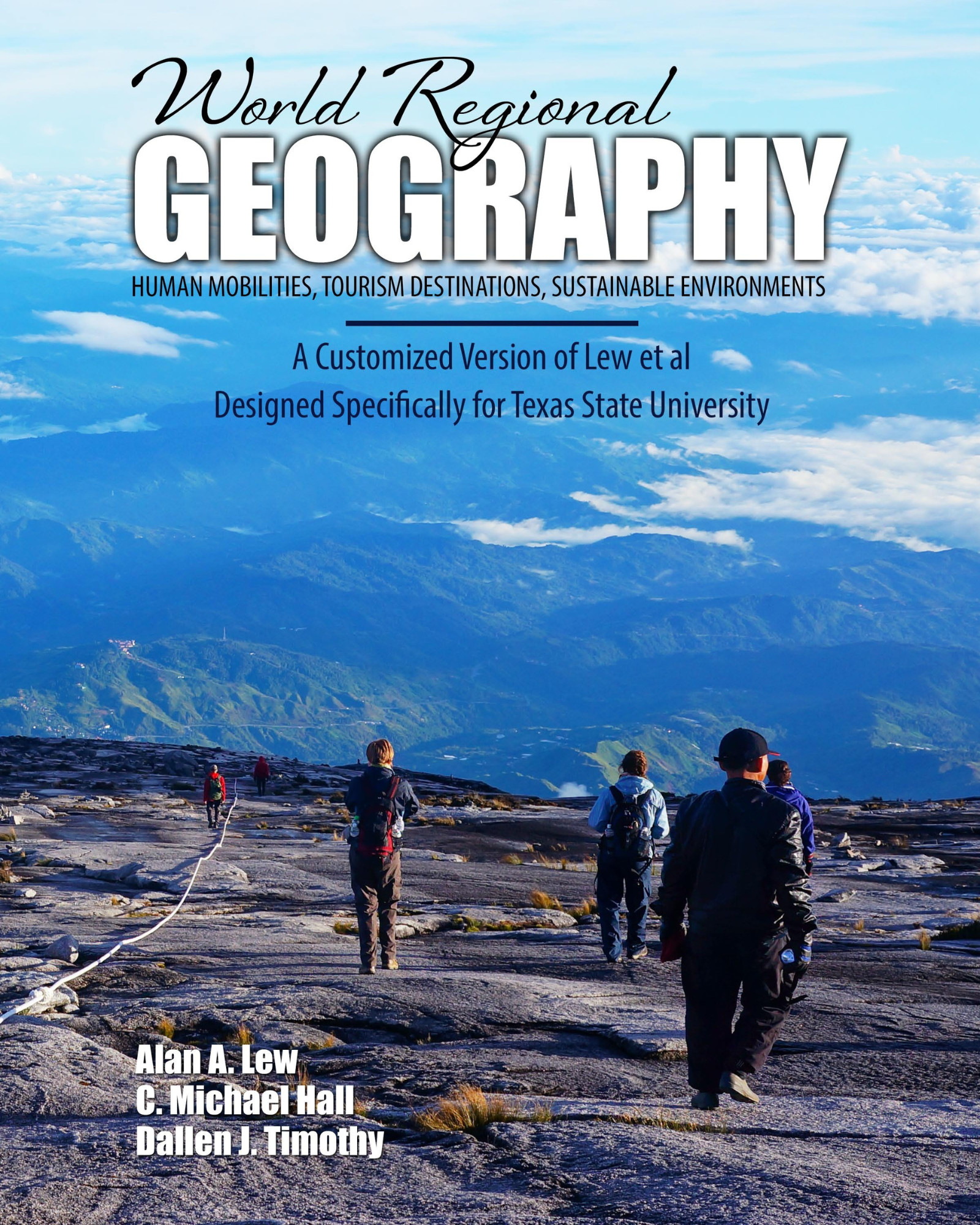

World Regional Geography: Human Mobilities, Tourism Destinations, Sustainable Environments: A Custom Version for Texas State University
Edition: 1
Copyright: 2024
Pages: 157
Choose Your Format
Ebook
$109.98 USD
World Regional Geography: Human Mobilities, Tourism Destinations, Sustainable Environments: A Custom Version for Texas State University provides a comprehensive introduction to the field of geography with an emphasis on the relationship between people, places, and environments across global regions. The text begins by defining geography and distinguishing between physical geography, focused on natural landscapes and environmental systems, and human geography, which examines globalization, mobility, and spatial patterns of human activity. It then explores major world regions, including the Russian Realm and Central Asia, Southeast Asia, and Oceania, Antarctica, and the world’s oceans. Each region is analyzed through both physical and human geographic perspectives, highlighting environmental conditions, cultural and population patterns, and the role of tourism and human mobility.
Preface
Chapter 1: Introduction to Geography
1.1 WHAT IS GEOGRAPHY?
Physical Geography and our Environment
Human Geography and Globalization
Chapter 2: The Russian Realm
Russia and the CIS
2.1 CENTRAL ASIA
Physical Geography of Central Asia
Human Geography of Central Asia
Countries and Tourism of Central Asia
Chapter 3: Southeast Asia
3.1 SOUTHEAST ASIA
Physical Geography of Southeast Asia
Human Geography of Southeast Asia
Countries and Tourism of Southeast Asia
Chapter 4: Oceania, Antarctica, and the Oceans
4.1 OCEANIA: AUSTRALIA AND THE PACIFIC ISLANDS
Physical Geography of Australia and New Zealand
Human Geography of Australia and New Zealand
Geography and Tourism of the Pacific Islands
4.2 ANTARTICA AND THE OCEANS
Physical Geography of Antarctica
Human Geography and Tourism of Antarctica
The Ocean World
MAPS
Dr. Brian Cooper is a Professor of Instruction and Undergraduate Coordinator in the Department of Geography and Environmental Studies within the College of Liberal Arts at Texas State University.