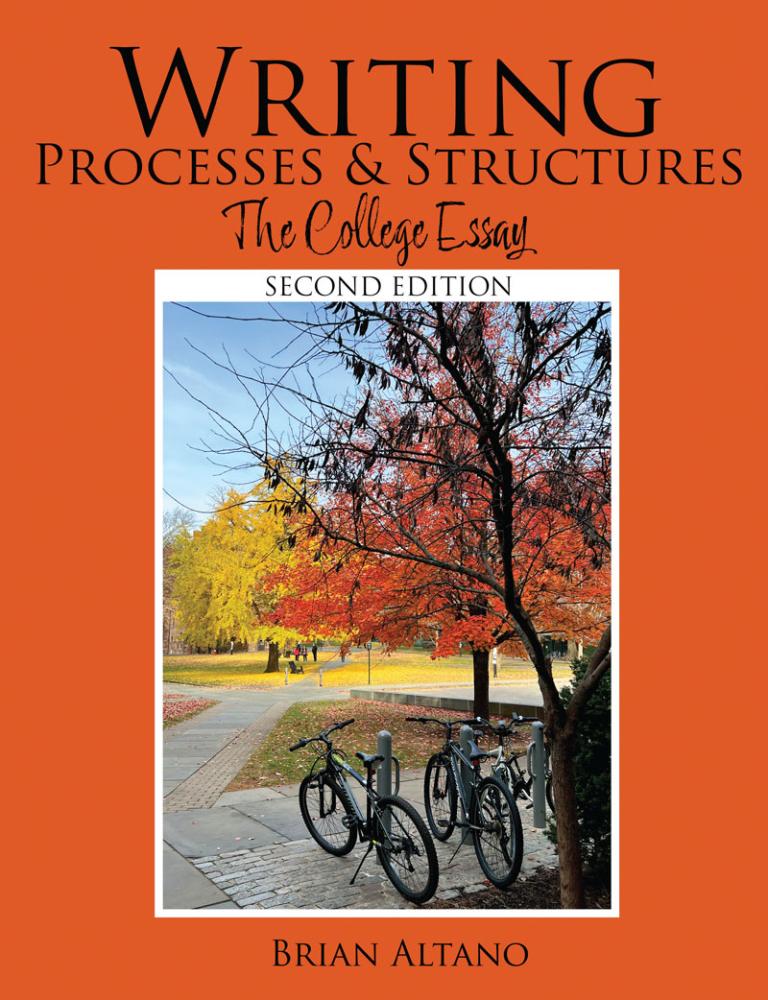
Writing Processes and Structures: The College Essay

Author(s): Brian Altano

Edition: 2

Copyright: 2022

Pages: 272

Choose Your Format

Choose Your Platform | Help Me Choose

Ebook

$38.59 USD

ISBN 9798765723005

Details Electronic Delivery EBOOK 180 days

Writing Processes and Structures: The College Essay is divided into seven Units, an Appendix, and an Answer Key. The Units represent rhetorical modes, or essay types: introduction to the five-paragraph essay, description, narration, process, comparison and contrast, and persuasion; the Appendix provides a summary of paragraph types, with the key words, the principal verb tenses, the structure, and the outline of each. There is an overview of the 10 types of journals, with additional journal entry suggestions. The Answer Key supplies responses to the grammar, reading comprehension, and discussion questions, as well as answers to the Unit Summary Sections. 

UNIT 1 THE BASICS
I. Parts of Speech
Verbs
Adjectives
Adverbs
Nouns
Prepositions
Conjunctions
Pronouns
Articles

II. Sentence Types and Punctuation
Sentence Patterns
Punctuation of Clauses and Identification of Sentence Pattern

III. Glossary of Terms
1. The Paragraph
2. The Essay
3. The Topic
4. The Journal

IV. Journal Type 1: The Personal Journal

V. The Peer Evaluation Form

UNIT 2 THE COLLEGE ESSAY
I. The College Essay
Structure of the Essay

II. FOCUS, UNITY, SUPPORT, AND COHERENCE IN THE ESSAY
Process for Writing an Essay

III. Vocabulary Acquisition: Using the Dictionary

IV. Grammatical Structures: Adjective Clauses and Phrases
Forms of Adjective Clauses
Reducing an Adjective Clause to an Adjective Phrase
Punctuating Adjective Clauses
Identifying Adjective Clauses and Phrases

V. Writing Skills: Symbolism and Figurative Language

VI. Journal Type 1: The Essay as Journal Entry

VII. Journal Type 2: The Self-Improvement Journal
Create a Personal Self-Improvement Plan

VIII. Graded Writing Assignment: Who Am I Really?

IX. Unit 2 Summary

X. Reflections on Your Progress

XI. Unit 2 Assignment Checklist

XII. Unit 2 Journal Summary

UNIT 3 DESCRIPTION ESSAYS
Description Essays
Prewriting Assignment

I. DESCRIPTION: AN INDUCTIVE APPROACH

II. VOCABULARY ACQUISITION: ADJECTIVES
Connotation
Literal and Figurative Meaning

III. Grammatical Structures: Subject–Verb Agreement

IV. WRITING SKILLS: THE THESIS STATEMENT
Types of Thesis Statements: Testing the Water or Jumping Right in
Two Types of Thesis Statements

V. Journal Type 3: Creative Listings

VI. Paraphrasing a Passage

VII. Graded Writing Assignment: Describe a Painting or Work of Art
Vocabulary

VIII. Unit 3 Summary

IX. Reflections on Your Progress

X. Unit 3 Assignment Checklist

XI. Unit 3 Journal Summary

UNIT 4 NARRATION ESSAYS

I. Introduction to Narration Essays

II. Vocabulary Acquisition: Verbs

III. Grammatical Structures: Independent Clauses

IV. Writing Skills: Outlining

V. Journal Type 4: The Dream Journal

VI. Graded Writing Assignment: A Night in Chicago
A Night in Chicago

VII. Unit 4 Summary

VIII. Reflections on Your Progress

IX. Unit 4 Assignment Checklist

X. Unit 4 Journal Summary

UNIT 5 PROCESS ESSAYS

I. Introduction to Process Essays
Structure of the Process Essay

II. VOCABULARY ACQUISITION: ADVERBS

III. Grammatical Structures: Modals

IV. Writing Skills: Proofreading

V. Journal Type 5: The Double-Entry Journal
Vocabulary
Outline of Points to Learn
Vocabulary for Finding an Apartment

VI. Graded Writing Assignment: Write a Process Essay on Observation and Deduction

VII. Unit 5 Summary

VIII. Reflections on Your Progress

IX. Part 5 Assignment Checklist

X. Unit 5 Journal Summary

UNIT 6 COMPARISON AND CONTRAST ESSAYS

I. Introduction to Comparison and Contrast Essays
The Comparison Essay
A. Brainstorming and the Process for Organizing and Writing Contrast Essays
B. Structure 1: Direct Comparison
C. Structure Ii: Separated Structure

II. Vocabulary Acquisition: Nouns

III. Grammatical Structures: Connectors or Discourse Markers

IV. Writing Skills: Enhancing Creativity

V. Journal Type 6: The Four-Entry Journal
Vocabulary

VI. Graded Writing Assignment: Compare and Contrast Two Languages

VII. Unit 6 Summary

VIII. Reflections on Your Progress

IX. Unit 6 Assignment Checklist

X. Unit 6 Journal Summary

UNIT 7 PERSUASION ESSAYS

I. Introduction to Persuasion Essays
Structure of the Persuasion Essay

II. Vocabulary Acquisition: Word Clusters

III. Grammatical Structures: Punctuation

IV. Writing Skills: Writing Evaluation

V. Journal Type 7: The Memorandum Journal

VI. Graded Writing Assignment: Write a Persuasion Essay on a Social Issue

VII. Unit 7 Summary

VIII. Reflections on Your Progress

IX. Unit 7 Assignment Checklist

X. Unit 7 Journal Summary

ESSAY Type Summary Charts

Brian Altano

Brian Altano is the author of 14 textbooks, including Writing Processes and Structures and Reading Processes and Structures, published by the University of Michigan Press, and Creative Grammar, a three-level grammar series published by Spotlight Learning. His most recent books are Public and Private Writing by Kendall Hunt and the Emerging Communicators for ESL published by Allwrite Editions. Prof. Altano has taught ESL, literature, and writing at Bergen Community College in Paramus, New Jersey for more than 25 years. Prof. Altano has twice been a Visiting Fellow at Princeton University, and has also held Visiting Professorships at Ramapo, Kean, Union, Middlesex, Rutgers, and N.J.I.T. He was the recipient of a Fulbright Fellowship in Florence, Italy and an Oldrini Foundation Fellowship in Rome, Italy. He has lectured extensively on language learning and translation at national conferences throughout the United States, Canada, and Europe. A professional translator and interpreter specializing in Italian, Spanish, French and and Latin, Prof. Altano has translated Notas Fuera Del Tiempo by Victor Arango (Spanish), the short fiction of Carlo Emilio Gadda (Italian), Alberto Moravia (Italian), and Guy de Maupassant (French), as well as computer and technical manuals and the legal documentation for the Parmalat Trial in Italy for the European Union.

Prof. Altano is also a professional storyteller, who has told his original stories in performances throughout the United States (New York, Miami, San Francisco, Chicago, Philadelphia, Austin), and in Austria, Venezuela, Italy, France, Canada, and Morocco. Much of his short fiction has also been published. Prof. Altano has also written and lectured extensively on educational issues. “Language Minority Crossover Students in the ESL Classroom” was a concept that Altano originated. It was later renamed “Generation 1.5.” Articles on this issue appeared in the Princeton University Fellows Report and in Innovations Abstracts (NISOD Publications). To address problems with remedial education, Prof. Altano also researched and wrote Grammar Without the Teacher, an innovative approach using a flipped classroom and technology to streamline remediation. Prof. Altano delivered lectures on the topic at the National TESOL Convention in New York, the New Jersey TESOL Convention in New Brunswick, NJ, and published articles in the Princeton University Fellows Report and in Innovations Abstracts (NISOD Publications). The online text of Grammar Without the Teacher is Prof. Altano’s second collaboration with Kendall Hunt Publishers.

Writing Processes and Structures: The College Essay is divided into seven Units, an Appendix, and an Answer Key. The Units represent rhetorical modes, or essay types: introduction to the five-paragraph essay, description, narration, process, comparison and contrast, and persuasion; the Appendix provides a summary of paragraph types, with the key words, the principal verb tenses, the structure, and the outline of each. There is an overview of the 10 types of journals, with additional journal entry suggestions. The Answer Key supplies responses to the grammar, reading comprehension, and discussion questions, as well as answers to the Unit Summary Sections. 

UNIT 1 THE BASICS
I. Parts of Speech
Verbs
Adjectives
Adverbs
Nouns
Prepositions
Conjunctions
Pronouns
Articles

II. Sentence Types and Punctuation
Sentence Patterns
Punctuation of Clauses and Identification of Sentence Pattern

III. Glossary of Terms
1. The Paragraph
2. The Essay
3. The Topic
4. The Journal

IV. Journal Type 1: The Personal Journal

V. The Peer Evaluation Form

UNIT 2 THE COLLEGE ESSAY
I. The College Essay
Structure of the Essay

II. FOCUS, UNITY, SUPPORT, AND COHERENCE IN THE ESSAY
Process for Writing an Essay

III. Vocabulary Acquisition: Using the Dictionary

IV. Grammatical Structures: Adjective Clauses and Phrases
Forms of Adjective Clauses
Reducing an Adjective Clause to an Adjective Phrase
Punctuating Adjective Clauses
Identifying Adjective Clauses and Phrases

V. Writing Skills: Symbolism and Figurative Language

VI. Journal Type 1: The Essay as Journal Entry

VII. Journal Type 2: The Self-Improvement Journal
Create a Personal Self-Improvement Plan

VIII. Graded Writing Assignment: Who Am I Really?

IX. Unit 2 Summary

X. Reflections on Your Progress

XI. Unit 2 Assignment Checklist

XII. Unit 2 Journal Summary

UNIT 3 DESCRIPTION ESSAYS
Description Essays
Prewriting Assignment

I. DESCRIPTION: AN INDUCTIVE APPROACH

II. VOCABULARY ACQUISITION: ADJECTIVES
Connotation
Literal and Figurative Meaning

III. Grammatical Structures: Subject–Verb Agreement

IV. WRITING SKILLS: THE THESIS STATEMENT
Types of Thesis Statements: Testing the Water or Jumping Right in
Two Types of Thesis Statements

V. Journal Type 3: Creative Listings

VI. Paraphrasing a Passage

VII. Graded Writing Assignment: Describe a Painting or Work of Art
Vocabulary

VIII. Unit 3 Summary

IX. Reflections on Your Progress

X. Unit 3 Assignment Checklist

XI. Unit 3 Journal Summary

UNIT 4 NARRATION ESSAYS

I. Introduction to Narration Essays

II. Vocabulary Acquisition: Verbs

III. Grammatical Structures: Independent Clauses

IV. Writing Skills: Outlining

V. Journal Type 4: The Dream Journal

VI. Graded Writing Assignment: A Night in Chicago
A Night in Chicago

VII. Unit 4 Summary

VIII. Reflections on Your Progress

IX. Unit 4 Assignment Checklist

X. Unit 4 Journal Summary

UNIT 5 PROCESS ESSAYS

I. Introduction to Process Essays
Structure of the Process Essay

II. VOCABULARY ACQUISITION: ADVERBS

III. Grammatical Structures: Modals

IV. Writing Skills: Proofreading

V. Journal Type 5: The Double-Entry Journal
Vocabulary
Outline of Points to Learn
Vocabulary for Finding an Apartment

VI. Graded Writing Assignment: Write a Process Essay on Observation and Deduction

VII. Unit 5 Summary

VIII. Reflections on Your Progress

IX. Part 5 Assignment Checklist

X. Unit 5 Journal Summary

UNIT 6 COMPARISON AND CONTRAST ESSAYS

I. Introduction to Comparison and Contrast Essays
The Comparison Essay
A. Brainstorming and the Process for Organizing and Writing Contrast Essays
B. Structure 1: Direct Comparison
C. Structure Ii: Separated Structure

II. Vocabulary Acquisition: Nouns

III. Grammatical Structures: Connectors or Discourse Markers

IV. Writing Skills: Enhancing Creativity

V. Journal Type 6: The Four-Entry Journal
Vocabulary

VI. Graded Writing Assignment: Compare and Contrast Two Languages

VII. Unit 6 Summary

VIII. Reflections on Your Progress

IX. Unit 6 Assignment Checklist

X. Unit 6 Journal Summary

UNIT 7 PERSUASION ESSAYS

I. Introduction to Persuasion Essays
Structure of the Persuasion Essay

II. Vocabulary Acquisition: Word Clusters

III. Grammatical Structures: Punctuation

IV. Writing Skills: Writing Evaluation

V. Journal Type 7: The Memorandum Journal

VI. Graded Writing Assignment: Write a Persuasion Essay on a Social Issue

VII. Unit 7 Summary

VIII. Reflections on Your Progress

IX. Unit 7 Assignment Checklist

X. Unit 7 Journal Summary

ESSAY Type Summary Charts

Brian Altano

Brian Altano is the author of 14 textbooks, including Writing Processes and Structures and Reading Processes and Structures, published by the University of Michigan Press, and Creative Grammar, a three-level grammar series published by Spotlight Learning. His most recent books are Public and Private Writing by Kendall Hunt and the Emerging Communicators for ESL published by Allwrite Editions. Prof. Altano has taught ESL, literature, and writing at Bergen Community College in Paramus, New Jersey for more than 25 years. Prof. Altano has twice been a Visiting Fellow at Princeton University, and has also held Visiting Professorships at Ramapo, Kean, Union, Middlesex, Rutgers, and N.J.I.T. He was the recipient of a Fulbright Fellowship in Florence, Italy and an Oldrini Foundation Fellowship in Rome, Italy. He has lectured extensively on language learning and translation at national conferences throughout the United States, Canada, and Europe. A professional translator and interpreter specializing in Italian, Spanish, French and and Latin, Prof. Altano has translated Notas Fuera Del Tiempo by Victor Arango (Spanish), the short fiction of Carlo Emilio Gadda (Italian), Alberto Moravia (Italian), and Guy de Maupassant (French), as well as computer and technical manuals and the legal documentation for the Parmalat Trial in Italy for the European Union.

Prof. Altano is also a professional storyteller, who has told his original stories in performances throughout the United States (New York, Miami, San Francisco, Chicago, Philadelphia, Austin), and in Austria, Venezuela, Italy, France, Canada, and Morocco. Much of his short fiction has also been published. Prof. Altano has also written and lectured extensively on educational issues. “Language Minority Crossover Students in the ESL Classroom” was a concept that Altano originated. It was later renamed “Generation 1.5.” Articles on this issue appeared in the Princeton University Fellows Report and in Innovations Abstracts (NISOD Publications). To address problems with remedial education, Prof. Altano also researched and wrote Grammar Without the Teacher, an innovative approach using a flipped classroom and technology to streamline remediation. Prof. Altano delivered lectures on the topic at the National TESOL Convention in New York, the New Jersey TESOL Convention in New Brunswick, NJ, and published articles in the Princeton University Fellows Report and in Innovations Abstracts (NISOD Publications). The online text of Grammar Without the Teacher is Prof. Altano’s second collaboration with Kendall Hunt Publishers.
