These guided activities were written because much research has shown that more learning takes place when the student is actively engaged and when ideas and concepts are developed by the student, rather than being presented by an authority - a textbook or an instructor. The activities presented are structured so that information is presented to the reader in some form (and equation, table, graph, figure, written prose, etc.) followed by a series of Construct-Your-Understanding Questions that lead the student to the development of a particular…
Students learn when they are activity engaged and thinking in class. The activities in this book are the primary classroom materials for teaching Calculus 1, using the POGIL method. Each activity leads students to discovery of the key concepts by having them analyze data and make inferences. The result is an "I can do this" attitude, increased retention, and a feeling of ownership over the material.
If you are interested in having instructor resources please reach out to POGILKHrep@kendallhunt.…
Thermodynamics, Statistical Mechanics & Kinetics: A Guided Inquiry was developed to facilitate more student-centered classroom instruction of physical chemistry using Process Oriented Guided Inquiry Learning (POGIL). These activities guide students through a wide variety of topics found in a typical undergraduate treatment of Thermodynamics, Statistical Mechanics, and Kinetics. When feasible, the activities incorporate a molecular point of view, supported by very simple models to help chemistry students grapple with the abstract, formal, and mathematical…
Process Oriented Guided Inquiry Learning (POGIL) is a method of instruction where each student takes an active role in the classroom. The activities contained in this collection are specially designed guided inquiry activities intended for the student to complete during class while working with a small group of peers. Each activity introduces essential organic chemistry content in a model that contains examples, experimental data, reactions, or other important information. Each activity is followed by a series of questions designed to lead the student through the thought processes that…
Quantum Chemistry & Spectroscopy: A Guided Inquiry was developed to facilitate more student-centered classroom instruction of physical chemistry using Process Oriented Guided Inquiry Learning (POGIL). The activities guide students through a wide variety of topics found in a typical undergraduate quantum physical chemistry course. The text introduces quantum phenomena, presents the postulates of quantum mechanics, and then applies these postulates to model problems of increasing sophistication – the particle-on-a-line (in one and two dimensions), the harmonic…
The Chem Activities found in Introductory Chemistry: A Guided Inquiry use the classroom guided inquiry approach and provide an excellent accompaniment to any one semester Introductory text. Designed to support Process Oriented Guided Inquiry Learning (POGIL), these materials provide a variety of ways to promote a student-focused, active classroom that range from cooperative learning to active student participation in a more traditional setting.
If you are interested in having instructor resources please reach out to …
In the newly updated 8th Edition, Chemistry: A Guided Inquiry continues to follow the evidence-based principles of inquiry learning, emphasizing the development of underlying chemistry concepts through analysis and interpretation of information. Part I includes activities that address most of the topics typically addressed in a first semester general chemistry course including atomic and molecular structure, states of matter, thermochemistry, and stoichiometry.
If you are interested in having instructor resources please reach out to…
In the newly updated 8th Edition, Chemistry: A Guided Inquiry continues to follow the evidence-based principles of inquiry learning, emphasizing the development of underlying chemistry concepts through analysis and interpretation of information. Part II includes activities that address most of the topics typically addressed in a second semester general chemistry course including thermochemistry, equilibrium, kinetics, acids and bases, oxidation-reduction processes, and thermodynamics.
If you are interested in having instructor resources…
Biochemistry: A Guided Inquiry uses the philosophy of Process Oriented Guided Inquiry Learning (POGIL) to teach the fundamental concepts of biochemistry. In these activities, students will work in teams to explore models of biochemical information and develop essential ideas so they can more fully understand the discipline. In addition, they will intentionally practice process skills including teamwork, information processing, critical thinking, and communication. The topics in this book cover the major themes of biomolecules, metabolism, and the replication…

These guided activities were written because much research has shown that more learning takes place when the student is actively engaged and when ideas and concepts are developed by the student, rather than being presented by an authority - a textbook or an instructor. The activities presented are structured so that information is presented to the reader in some form (and equation, table, graph, figure, written prose, etc.) followed by a series of Construct-Your-Understanding Questions that lead the student to the development of a particular…
If you are interested in having…

Topics addressed in this collection of 22 POGIL activities for Environmental and Earth Science address important concepts related to the biosphere, the hydrosphere, the atmosphere, the geosphere, and the anthroposphere. Besides the careful structuring of guided inquiry questions that allow students to construct their own understanding, each activity intentionally builds student fluency in one or two of the process skills of communication, teamwork, management, information processing, critical thinking, problem solving or metacognition/assessment.
…
This activity is written for upper-level biology courses and aims to acquaint students with the function of transcription factors, especially in determining the fate of cells. Students who complete this activity will explain and illustrate how cells with the same DNA produce different proteins and predict gene activity based on relevant gene regulation factors. Process skill: forming an argument or reaching a conclusion supported with evidence.
POGIL eBooks are delivered through VitalSource – the world’s leading platform for…

Calorimetry, experimental design. This guided inquiry laboratory experience is built for students to get reliable data with appropriate facilitation and includes Pre- and Post-Experiment Questions along with the actual experimental method to be followed during a typical three-hour lab period.
…
Acid-base titrations. This guided inquiry laboratory experience is built for students to get reliable data with appropriate facilitation and includes Pre- and Post-Experiment Questions along with the actual experimental method to be followed during a typical three-hour lab period.
…
Viscosity, vapor pressure, surface tension. Lewis structures and molecular shapes. This guided inquiry laboratory experience is built for students to get reliable data with appropriate facilitation and includes Pre- and Post-Experiment Questions along with the actual experimental method to be followed during a typical three-hour lab period.
…
Densities of liquids and solids. This guided inquiry laboratory experience is built for students to get reliable data with appropriate facilitation and includes Pre- and Post-Experiment Questions along with the actual experimental method to be followed during a typical three-hour lab period.
…
Solubility rules, ionic equations. Lewis structures and molecular shapes. This guided inquiry laboratory experience is built for students to get reliable data with appropriate facilitation and includes Pre- and Post-Experiment Questions along with the actual experimental method to be followed during a typical three-hour lab period.
…
Stoichiometry, limiting reactants. This guided inquiry laboratory experience is built for students to get reliable data with appropriate facilitation and includes Pre- and Post-Experiment Questions along with the actual experimental method to be followed during a typical three-hour lab period.
…
Electron configuration, paramagnetism, diamagnetism. This guided inquiry laboratory experience is built for students to get reliable data with appropriate facilitation and includes Pre- and Post-Experiment Questions along with the actual experimental method to be followed during a typical three-hour lab period.
…
Melting points of solids and mixtures. This guided inquiry laboratory experience is built for students to get reliable data with appropriate facilitation and includes Pre- and Post-Experiment Questions along with the actual experimental method to be followed during a typical three-hour lab period.
…
Free energy and spontaneity. This guided inquiry laboratory experience is built for students to get reliable data with appropriate facilitation and includes Pre- and Post-Experiment Questions along with the actual experimental method to be followed during a typical three-hour lab period.
…
The scientific process. This guided inquiry laboratory experience is built for students to get reliable data with appropriate facilitation and includes Pre- and Post-Experiment Questions along with the actual experimental method to be followed during a typical three-hour lab period.
…
Gas properties. This guided inquiry laboratory experience is built for students to get reliable data with appropriate facilitation and includes Pre- and Post-Experiment Questions along with the actual experimental method to be followed during a typical three-hour lab period.
…
Lewis structures and molecular shapes. This guided inquiry laboratory experience is built for students to get reliable data with appropriate facilitation and includes Pre- and Post-Experiment Questions along with the actual experimental method to be followed during a typical three-hour lab period.
…
Chemical equilibrium. This guided inquiry laboratory experience is built for students to get reliable data with appropriate facilitation and includes Pre- and Post-Experiment Questions along with the actual experimental method to be followed during a typical three-hour lab period.
*POGIL eBooks are delivered through VitalSource – the world’s leading platform for accessing, consuming, and engaging with digital textbooks and course materials. While designed to be used anywhere on a myriad of devices, users are able to print two watermarked pages…
This collection of 12 POGIL activities is aimed at introductory-level Anatomy and Physiology students. Topics include body organization, homeostasis, energetics, the circulatory system, nephrons, and an introduction to immunology. A bonus guided inquiry activity introduces medical terminology and contains an appendix with common medical prefixes, roots, and suffixes.
…
POGIL Laboratory Activities for Chemistry are specifically designed to incorporate and strengthen inquiry thinking patterns, process skills (such as teamwork, experimental design, and data pooling), and reflection and application skills. The procedures are built for students to get reliable data with appropriate facilitation. Each activity includes Pre- and Post-Experiment Questions along with the actual experimental method to be followed during a typical three-hour lab period. As with all POGIL materials, students should work in self-directed teams with the facilitator as a guide. Each…
Aligned with the National Art Education Association's Position Statement on Visual Literacy, and their Position Statement on Using Quality Resources to Build Curriculum, each activity in the POGIL Elements of Art A Guided Inquiry is designed to be students’ very first introduction to a fundamental elements of art concept. More than 286 artworks, representing artworks from prehistory to the present day, by artists from 76 nations representing Asian/South Asian, Black, Indigenous, Latine, and White artists, and including women and queer artists, form the backbone of the guided inquiry…
Students can follow a guided inquiry approach as they learn chemistry in the classroom. General, Organic, and Biological Chemistry: A Guided Inquiry serves as an accompaniment to a GOB Chemistry text. It can suit the one- or two-semester course. This supplemental text supports Process Oriented Guided Inquiry Learning (POGIL), which is a student-focused, group-learning philosophy of instruction. The materials offer ways to promote a student-centered science classroom with activities. The goal is for students to gain a greater understanding of chemistry through exploration.
…
Students learn when they are actively engaged and thinking in class. The activities in this book are the primary classroom materials for teaching Anatomy and Physiology, using the POGIL method. The result is an "I can do this" attitude, increased retention, and a feeling of ownership over the material.
If you are interested in having instructor resources please reach out to POGILKHrep@kendallhunt.com. A coloring book to accompany each activity is now…
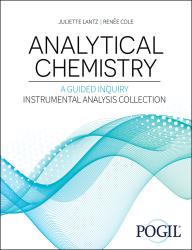
The Instrumental Analysis Collection contains 20 activities developed by the ANA-POGIL consortium that span the range of topics likely to be covered in a semester-long instrumental analysis course: Analytical Tools, Statistics, Electrochemistry, Spectrometry, and Chromatography and Separations. All activities have been reviewed and classroom tested by multiple instructors at a variety of institutions. Each written activity includes content and skill-development goals as well as a list of prerequisites. The topical treatment of concepts, as well as advanced coverage of analytical principles…
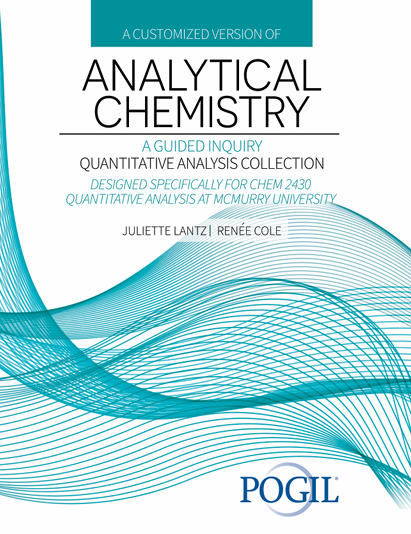
The Quantitative Analysis Collection contains 28 activities developed by the ANA-POGIL consortium that span the range of topics likely to be covered in a semester-long quantitative analysis course: Analytical Tools, Statistics, Equilibrium, Electrochemistry, Spectrometry, and Chromatography and Separations. All activities have been reviewed and classroom tested by multiple instructors at a variety of institutions. Each written activity includes content and skill-development goals as well as a list of prerequisites. The topical treatment of concepts, as well as advanced coverage of…