
This manual is designed to be paired with the General Chemistry component of a GOB course which annually enrolls about 1000 mostly pre-nursing and agricultural science students at Texas Tech University, but it could also be paired with the first semester of two-semester General Chemistry sequence. A digital site is provided for pre-laboratory assignments, submission and analysis of data in a laboratory report, and post-laboratory questions with each component being fully machine graded. Consequently, the printed manual contains only what is required in the physical laboratory: procedures…
New Edition Now Available!
Lab Manual for Chem 105: Chemistry in Context 1 provides an introduction to the concepts of chemical research such as: chemical lab safety, identifying inorganic salts, identifying organic materials, measuring gas volumes, measuring liquid volumes, measuring concentration, determining measurement accuracy, determining reaction stoichiometry, and making pH measurements.
Student Workbook for Organic Chemistry is targeted practice on those areas that we have identified as trouble hotspots for students. Each section is written independently from another and covers the whole topic with information and practice. It can be helpful for both organic I and organic II students as it covers material learned in both courses that tend to be forgotten along the way.
Steven Chung's Organic Chemistry Laboratory Manual introduces students to standard techniques of organic chemistry and applies these techniques to the isolation and purification of products. It is suited for both a one-semester survey course or the first of a two-semester sequence. All experiments are readily completed in a three-hour laboratory period.
*Purchase provides access to KHPcontent and ALEKS*
Chemistry is all around us. We use it often, although unknowingly, and it helps us each day to perform our daily tasks. How can anyone use something constantly and not know anything about how it works?
Everyday Chemistry helps the average person learn about the chemistry they use every day. It is designed to be used for an introductory chemistry class that will satisfy the need for a lecture course requirement in a science for a student to graduate with a bachelor’s degree from most colleges. This book is meant to teach chemistry with interesting insights…
Chemistry is the study of being and becoming in the material world. It is an experimental science that requires careful observation of physical properties of substances, as well as how they are changed by chemical reactions.
In Chemistry 151: Lab Manual, students will discover how pure elemental matter can light up the dark with spectral brilliance, and feel how it can warm their surroundings with the heat of a chemical reaction. They will measure the potential of metallic elements to power electronic gadgets, and confirm a fundamental…
Students taking an introductory physical science course can easily get buried in the sheer quantity of information that they are required to understand and apply for success. A Survey of Physics and Chemistry Workbook was created such that students taking this type of course with a focus on physics and chemistry could keep all their notes and worked-out problems together.
How do doctors measure what diseases you have? Have you ever wondered how a hospital can tell if it’s a heart attack or just indigestion? How do pregnancy tests measure if you’re pregnant?
In Thinking Through the Laboratory: A Chemistry 130L Workbook, we explain the fundamental chemistry behind diagnostic tests and create a lab environment to enhance the understanding of diagnostic science. Students will evaluate case files and perform point-of-care tests on samples with the goals of understanding the mechanisms that cause disease and the signals that…
Thinking Through the Laboratory: An Organic Chemistry II Workbook is a transformative tool that prompts students to predict, think, do, and reflect during a laboratory experience. This all-in-ane workbook is an interactive hybrid of the traditional laboratory manual and laboratory notebook. Every aspect of this workbook is designed to encourage thinking before, during, and after performing an action.
Unique features of this workbook are:
- Integrated thought and prediction features entitled "Some Assembly Required". These features are designed to…
To the student...Take advantage of the features of this lab book to help you succeed. For all the labs read the background, it will help clarify procedures, it will help you focus, and it will help you with calculations and other questions.
Read the procedure ahead of time. If you have a picture in mind of what you will be doing, it will speed things up and help you avoid pitfalls along the way.
Write notes to yourself; each lab has a “Notes” page for this purpose.
For all labs, the answers to pre-lab and post-lab calculated problems are given; use them as…
Students can follow a guided inquiry approach as they learn chemistry in the classroom. General, Organic, and Biological Chemistry: A Guided Inquiry serves as an accompaniment to a GOB Chemistry text. It can suit the one- or two-semester course. This supplemental text supports Process Oriented Guided Inquiry Learning (POGIL), which is a student-focused, group-learning philosophy of instruction. The materials offer ways to promote a student-centered science classroom with activities. The goal is for students to gain a greater understanding of chemistry through exploration.
…
The Instrumental Analysis Collection contains 20 activities developed by the ANA-POGIL consortium that span the range of topics likely to be covered in a semester-long instrumental analysis course: Analytical Tools, Statistics, Electrochemistry, Spectrometry, and Chromatography and Separations. All activities have been reviewed and classroom tested by multiple instructors at a variety of institutions. Each written activity includes content and skill-development goals as well as a list of prerequisites. The topical treatment of concepts, as well as advanced coverage of analytical principles…
The Quantitative Analysis Collection contains 28 activities developed by the ANA-POGIL consortium that span the range of topics likely to be covered in a semester-long quantitative analysis course: Analytical Tools, Statistics, Equilibrium, Electrochemistry, Spectrometry, and Chromatography and Separations. All activities have been reviewed and classroom tested by multiple instructors at a variety of institutions. Each written activity includes content and skill-development goals as well as a list of prerequisites. The topical treatment of concepts, as well as advanced coverage of…
Chemistry: Atoms First 2e is a peer-reviewed, openly licensed introductory textbook produced through a collaborative publishing partnership between OpenStax and the University of Connecticut and UConn Undergraduate Student Government Association. This text is an atoms-first adaptation of OpenStax Chemistry 2e. The intention of “atoms-first” involves a few basic principles: first, it introduces atomic and molecular structure much earlier than the traditional approach, and it threads these themes through subsequent chapters. This approach may be chosen as a way to delay the introduction of…
Just as the laboratory is designed to support and enhance student understanding of material learned/ learning/to be learned in lecture, Introductory General Chemistry Laboratory Experiments is designed to support and enhance the textbook. As such, the introductory material for each experiment has not been written as a substitute for or complete description of the topics covered. What we have attempted to do herein is to provide a brief description of the underlying theory of each experiment and included the main topics in bold to highlight the…
Agricultural Biochemistry focuses on the more traditional fields of biochemistry with an emphasis on understanding the different biomolecules and their importance in the larger more complex organisms studied by animal, food, and plant scientists. It will build upon the basic inorganic and organic chemistry concepts you have learned in other courses. The structure and function of the biomolecules and their applications in agriculture will be emphasized. A review of cells and their structures and an introduction to basic metabolic reactions and pathways will be…
Preparatory General Chemistry: Framework for Success is designed to provide college students who are not yet ready for general chemistry with the skills, content, and resources that are proven effective for achieving success in college chemistry courses. This workbook takes students step-by-step in learning effective strategies to support their journey into STEM majors. The authors are faculty members who have designed a unique preparatory chemistry course with a track record of data that supports the efficacy of targeting and preparing first year college students…
The NEW second edition of Sinton's Laboratory Manual for Biochemistry represents a complete update and revision from the first edition, including many new exercises. In response to the increased importance of NMR and food in biochemistry, for example, several new exercises have been added: amino acid pK2, determination via protein NMR, solution carbohydrate identification via carbon NMR, and explorations of food carbohydrate and fat content. And while the original catalase purification scheme and associated activity studies remain (all-be-it updated), an entirely…
The second edition of Sinton’s Laboratory Manual for General, Organic, and Biochemistry represents a complete update and revision from the first edition, including many new exercises designed to enhance coverage of important topics such as organic synthesis, buffers, and molecular visualization. In addition, all of the artwork from the first edition has been updated, as well as the appendix and faculty manual.
Laboratory Experiments for General Chemistry, Fourth Edition updates and expands on earlier editions of this lab manual and is designed for the conventional two-semester General Chemistry sequence that is required for most STEM and pre-health programs. The experiments cover a wide range of topics including physical and chemical properties, stoichiometry, gas laws, spectrophotometry, qualitative analysis, acids and bases, kinetics, equilibrium, thermodynamics, electrochemistry, and nuclear chemistry. The introduction to each experiment has been revised to more clearly and…
eBook Version
You will receive access to this electronic text via email after using the shopping cart above to complete your purchase.
The cover art represents how the presence of certain chemicals in natural resources such as water can have an impact on the state of our world. The authors of this book believe that understanding the fundamental science behind issues in sustainability and environmentalism is just as important as taking action on those issues.
Written with non-science majors in mind, …
Chemistry is truly the “Central Science” and is fundamental to many scientific disciplines, since it provides the foundation for understanding the role atoms, ions, molecules, and formula units play in the composition and function of life. General Chemistry I Laboratory Manual (2nd Edition) is unique in the sense it guides students through experiences they would likely only encounter as a Chemistry major; experiences that make them more well-rounded, proficient science majors, and prepare them for the second semester General Chemistry II Laboratory and the Open…
Thinking Through the Laboratory: An Organic Chemistry I Workbook is a transformative tool that prompts students to predict, think, do and reflect during the course of a laboratory experience. This all-in-one workbook is an interactive hybrid of the traditional laboratory manual and laboratory notebook. Every aspect of this workbook is designed to encourage thinking before, during, and after performing an action.
Unique features of this workbook are:
- Experimental procedures that are image-driven as opposed to being presented…
This General Chemistry Laboratory manual consists of experiments designed to introduce to a student new to chemistry basic chemical concepts and techniques. Each lab consists of an introduction, where the major concepts of the experiments are explained, safety instruction, and a step-by-step procedure.
The major learning outcomes emphasized in this lab manual are as followed:
- Develop problem solving skills
- Perform accurate and precise quantitative measurements
- Interpret experimental results and draw reasonable conclusions
- Analyze data…
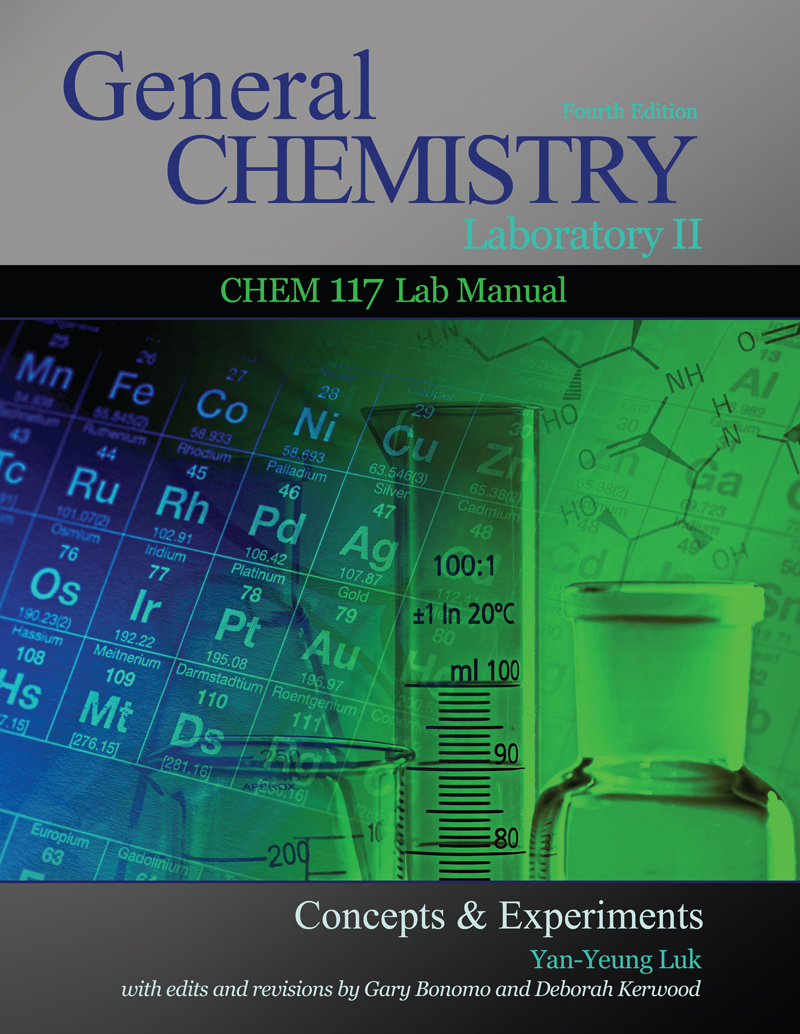
General Chemistry Laboratory II: CHEM 117 Lab Manual builds upon concepts and techniques that were presented in the first semester of the General Chemistry Laboratory course as well as introducing the students to labs that will help them prepare for more advance Chemistry courses. The format of the manual is consistent with that of the first semester where each lab begins with an introduction in which the main concepts of the experiment are described. The introduction is followed by safety instructions and the experimental procedure.
Thinking Through the Laboratory: A Chemistry 102 Workbook transformative tool that prompts students to predict, think, do, and reflect during the course of a laboratory experience. This all-in-one workbook is an interactive hybrid of the traditional laboratory manual and laboratory notebook. Every aspect of this workbook is designed to encourage thinking before, during, and after performing an action.
Unique features of this workbook are:
- Experimental procedures that are image-driven as opposed to being presented in a written format. …
This purchasing option contains only the eBook version of the Lab Manual. To order the textbook and lab manual PAK visit www.kendallhunt.com/rappazzo
General Chemistry I Workbook is designed to provide open access to education for all kinds of students regardless of school background or lack of it. All you have to do is read the simple discussions of such topics as measurement, identities of chemicals, how we quantify chemicals, etc. You will fill in the blanks here and there, and follow prompts to help you solve simple problems. In today's world of technology and unseen dangers to our health everyone is expected to understand basic chemistry. Here then, is a guide into general chemistry.
This laboratory manual is designed for traditional two-semester college level general chemistry 1 and 2 courses. The content provides reinforcing practice of the major concepts in general chemistry. The activities in this manual will give students experience in safety, the meaningful use of statistics, comparing experimental results with theoretical results, spectrophotometry, chemical engineering, and more. There is a capstone guided discovery lab where students determine their own procedures to separate and identify metal ions in a water sample. Very popular with students, it has been…
The print option offers both textbook and lab manual in print format, whereas the ebook option will deliver both textbook and lab manual digitally in the same ebook code.
Biochemistry and Cell Biology: The Science of Life provides an overview of the chemical and biological processes associated with life. Chapter topics include Biochemical Pathways, Enzymes, Mitosis, Bioengineering and Biotechnology, and more!
Biochemistry and Cell Biology features:
- A study tip at the start of each…

Interactive Workbook for General Chemistry II is designed to allow general chemistry students a clear access to intricate topics. Using simple language, this workbook discusses topics that are perceived as difficult such as the interaction of chemicals with light otherwise known as spectroscopy, the speed with which chemicals change known as kinetics, leading to formation of new products and back again to reactants i.e. equilibrium, how chemicals produce electricity known as electrochemistry, and…
This manual, Introduction to Chemistry Lab Manual, is written for undergraduate students taking a General Chemistry laboratory course concurrently with General Chemistry. This is written primarily for those taking Chem 171 at Rutgers, The State University of New Jersey, however would be applicable in most any General Chemistry laboratory course. The purpose of a General Chemistry laboratory is not only to reinforce concepts taken from lecture through experimentation, but also to develop the student's experimental techniques. Beginning with elementary…
Topics discussed in my CHEM-103 lectures include:
- Scientific Methods and Measurements
- Atomic Structure
- The Mole Concept
- Stoichiometry
- Thermochemistry
- The Periodic Table
- Molecular Structure and Geometry
- Gases, Liquids, Solids, and Solutions
- Chemical Kinetics
- Chemical Equilibrium
- Acids, Bases, and Buffers
- Oxidation, Reduction, and Electrochemistry
- Nuclear Chemistry
General Chemistry I & II Laboratory Manual is a compilation of general chemistry labs that are designed to incorporate essential laboratory skills, complement instruction in General Chemistry I and II, foster inquiry, and help to teach both individual skills and teamwork. The labs and sequence are designed so that all students, regardless of background, will be able to be successful, but challenging enough that all students will learn.

This lab manual was designed for use in the Intensive General and Quantitative Analytical Chemistry laboratory courses (CH111, CH112, and CH201) at Boston University. The topics introduced in these labs include many of the fundamental concepts that are ubiquitous to the general chemistry curriculum: gas laws, solubility reactions, acid/base chemistry, spectroscopy, thermochemistry, equilibrium, and kinetics. Additionally, quantitative analysis adds an emphasis on experimental design, statistical treatment of data, advanced topics in spectrophotometry, critical thinking, scientific…
This lab manual was designed for use in the General and Quantitative Analytical Chemistry courses (CH109/110) at Boston University. The topics introduced in these labs include many of the fundamental concepts that are ubiquitous to the general chemistry curriculum: gas laws, solubility reactions, acid/base chemistry, spectroscopy, thermochemistry, equilibrium, and kinetics. Additionally, quantitative analysis adds an emphasis on experimental design, statistical treatment of data, advanced topics in spectrophotometry, critical thinking, scientific communication, and research.
The…
Bioorganic Chemistry Laboratory Experiments: Custom Edition for BCH 3023 University of North Florida is designed to give instructions for safely completing a series of college level experiments in the areas of organic and biological chemistry. It should accompany a semester lecture course such as bioorganic chemistry for non-science majors. Strong emphasis is placed upon the importance of the solubility of both organic and non-organic substances in aqueous (water) and non-aqueous environments. This is quite pertinent since the majority of human body mass is water…


Three new experiments are included in this 3rd edition, Atomic Emission and Flame Tests, Colligative Properties, and Human Digestion.
An extensive safety review has been done for this 3rd edition, which resulted in removing two labs with higher fire risk and in removing some of the most hazardous reagents in the experiments in the Organic Chemistry section.
An effective health sciences curriculum stimulates the student to progressively assemble a professional knowledge base. Biochemistry, especially when emphasizing the clinical application of the science, provides a solid foundation for future professional course work, including the subjects of pathophysiology, pharmacology, toxicology, clinical medicine, and therapeutics.
Clinical Biochemistry for Health Science Students provides a basic introduction to biochemistry for the health science practitioner. Beginning with the basics of solution chemistry and…
Kobrak’s Experiments in General Chemistry provides a complete first-year laboratory curriculum for students in scientific and pre-medical chemistry. The experiments represent a balance of synthesis and analysis experiments that meets the American Chemical Society’s curriculum guidelines for breadth without sacrificing depth. The procedures are easy to implement, reliable and inexpensive. Compared to other books on the market, the experiments are environmentally benign. In particular, the book includes a qualitative analysis scheme that avoids the use of lead…

Can organic chemistry mastery be facilitated by logical topic ordering and select concept problems that promote fundamental understanding? “Sequential Organic Chemistry” aims toward these objectives simply and concisely, without sacrificing core topics in conventional texts. Coverage is suitable for science majors and pre-professionals.

This laboratory manual is designed for use in one-semester introductory chemistry courses. The experiments use basic equipment found in any chemistry laboratory.
Why this is the right choice for your intro chem class?
- Developed by dedicated and experienced chemical educators.
- Classic experiments and new activities to build student experience and understanding of chemistry.
- Tried and tested over many years by students with clear and detailed instructions.
- Mini-scale to minimize chemical use and chemical waste.
- Fun and interesting labs that…